
Public Health Voices: Guest Essay by Naomi Jason Redlener
Until this spring, Ukraine was a place I knew mostly through headlines. Every update seemed to include another statistic—a family displaced, or another day of deadly air attacks on the capital city, Kyiv. The stories were heartbreaking, but they also felt distant. It is surprisingly easy for these statistics to make real humans and emotions feel abstract.
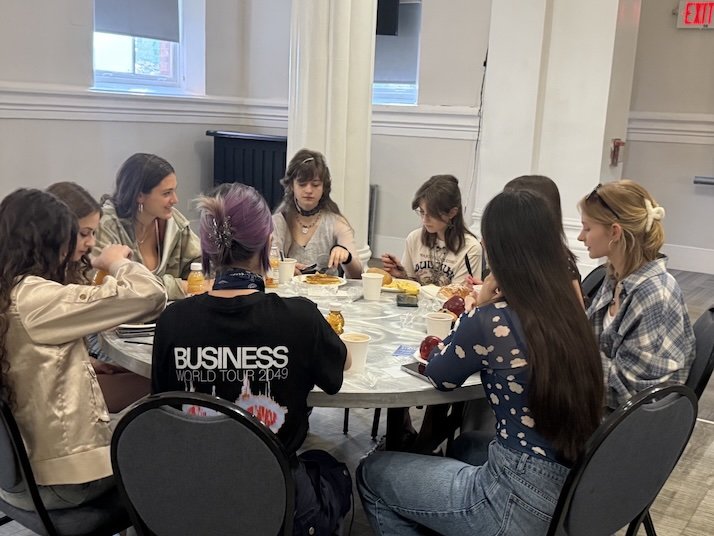
Then I spent a day with a group of Ukrainian high school students, ages ranging from 14 to 18, invited to the U.S. for the Genius Olympiad. Each year, after a highly selective, nationwide competition, top students from each country travel to Rochester, New York to highlight their skills and compete in many different categories: speech, music, art, science, etc.
Before meeting them, I expected our differences to define our conversations. I overprepared, mentally scripting our conversations because I worried that we’d have nothing in common. They had grown up in a country at war, while my biggest concerns revolved around AP exams, college applications, and sports. I assumed that the gap between our lives would be impossible to ignore.
Instead, the opposite happened.
Within minutes, conversations shifted naturally from introductions to music, favorite foods, sports, siblings, and their curiosity about my life and New York City. One student proudly showed me pictures of her dog, prompting everyone else to scroll through their camera rolls in search of their own pets. Someone complained about how stressful preparing for science competitions could be, while another joked that no matter what country you come from, teenagers are always stressed. The conversations felt familiar, I didn’t have to use my prepared scripts; we all loved the same things and the possibilities of what we could bond over was endless.
The similarities became even more striking because they existed alongside realities that were anything but ordinary.
As conversations deepened, the war emerged—not as the center of every discussion, but as a constant presence woven into their everyday lives. One student mentioned that her family members now lived in different countries after being displaced. Another showed me videos of her building in rubble after being struck by a bomb. Their stories were matter-of-fact, almost a routine part of their lives.
That normalcy was unsettling.
For these students from Ukraine emergency sirens signaling another drone or missile attack was part of the background noise of their life. I understood something unsettling: extraordinary hardship and danger may eventually become ordinary for the people living through it.
Yet none of them introduced themselves through tragedy.
They introduced themselves through their passions.
After all, the reason they had traveled across the world was not because of the war—it was because of their research or their creativity. Each student had spent months, sometimes years, developing projects worthy of international competition. Listening to them explain their work, I realized that every presentation represented far more than an academic achievement. It represented persistence and resilience.
Before meeting them, I thought resilience meant recovering from hardship after it had ended. These students demonstrated something different: resilience can also mean preserving as the hardship and the threats continue. They did not wait for life to become easier before pursuing their ambitions. They were building their futures in the middle of instability.
As teenagers, we are often told to dream big, but those words usually assume that the opportunity to dream is guaranteed. Meeting these students reminded me that for many people, pursuing an education, conducting research, or simply planning for the future requires an active choice to believe in your future.
Preparing my scripts before we met, I viewed these students primarily through the lens of war. Their hardships came before their individuality. Meeting them made me realize their human traits far overshadowed their challenges.
Within 15 minutes, we weren’t talking about geopolitical conflict. I was thinking about the girl who shared her favorite dessert recipe, the student who laughed after teaching me a Ukrainian curse word, and the conversations about college, family, and pop culture that could have happened in any high school cafeteria. We all worry about our futures. We all seek acceptance, chase goals, complain about school, and laugh over insignificant moments.
News reports often reduce people to statistics because numbers are easier to summarize than lives. Spending a day with these students reminded me that behind every headline is someone with a favorite song, an unfinished science project, a group of friends, and dreams that refuse to disappear simply because the world around them has changed.
That is what I will remember most—not the war that first introduced me to Ukraine, but the students who showed me that resilience is not only surviving adversity. Sometimes, it is refusing to let adversity become your defining trait.
Naomi is a rising senior at the High School for American Studies at Lehman College, Bronx, New York City. She helped welcome a group of 39 Ukrainian high school students who arrived in New York on June 7, 2026 to participate in the international Genius Olympiad competitions.

